

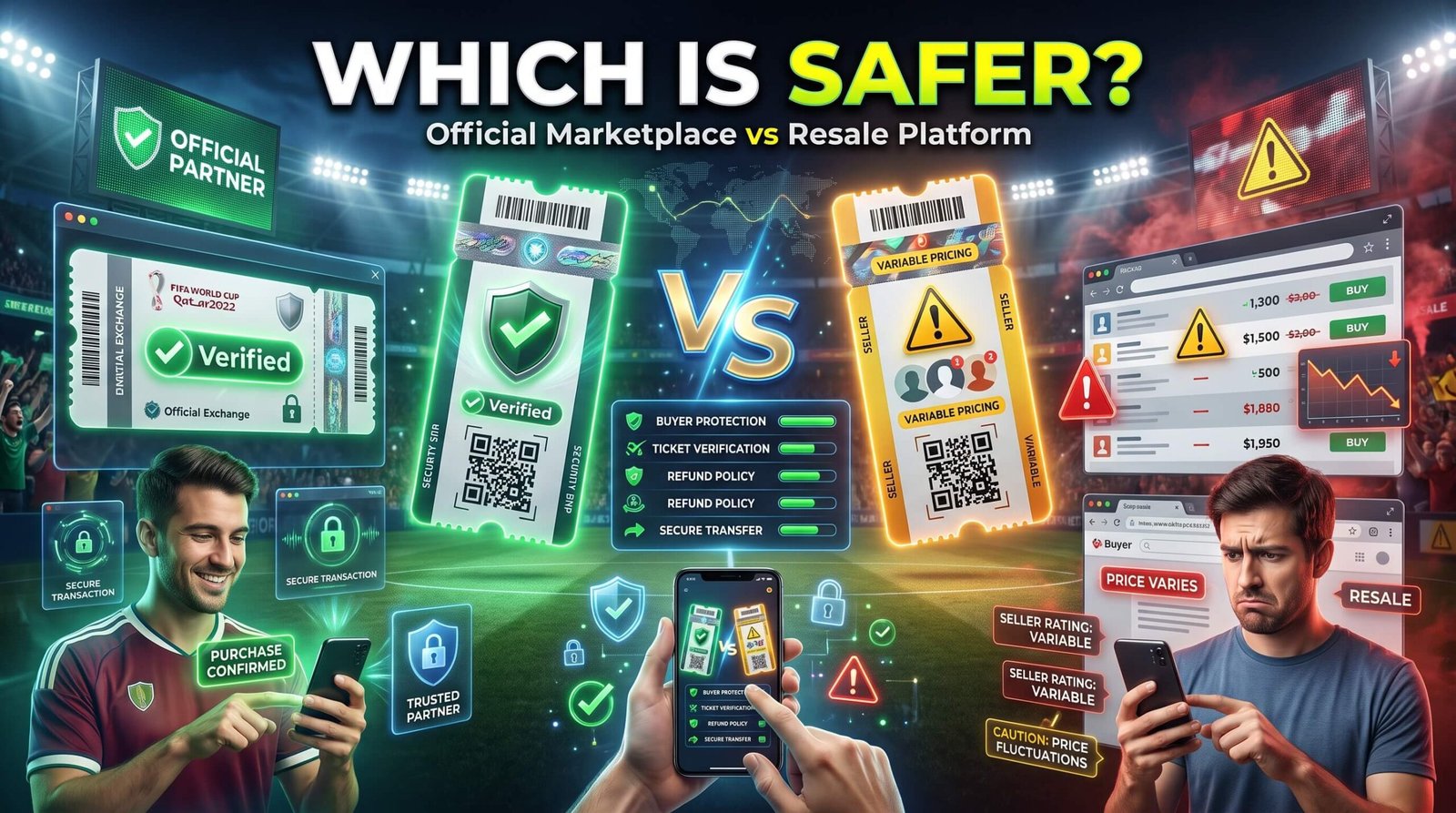
Both platforms will tell you they’re the safe choice. FIFA says its own marketplace is the only “official and secure” way to resell or buy World Cup tickets. StubHub says every order is “100% guaranteed” by its FanProtect policy. But this tournament has actually put both claims to the test in real time — and the results have been messier than either company’s marketing suggests.
Here’s an honest, side-by-side look at how each platform actually works, what’s gone wrong for real fans during this exact World Cup, and which one genuinely offers more protection.
The Quick Comparison
| FIFA Resale/Exchange Marketplace | StubHub | |
|---|---|---|
| Official FIFA-authorized channel? | Yes — the only one | No |
| Fees | 15% to buyer, 15% to seller (up to 30% combined) | Service fees vary by listing |
| Guarantee | None on whether a listing sells or a ticket is delivered | FanProtect: refund or “comparable” replacement |
| Availability | Limited, listings can vanish quickly | Generally wider selection, especially last-minute |
| Ticket validity risk | Very low — tickets stay inside FIFA’s system | Real risk this tournament — see below |
| Price control | Market pricing (except Mexico/Toronto, capped at face value) | Market pricing, no cap |
How the FIFA Resale Marketplace Actually Works
The FIFA Resale/Exchange Marketplace is the only channel FIFA officially authorizes for buying or reselling standard World Cup tickets after the original sale. It’s built directly into FIFA’s own ticketing system, so a ticket bought there stays digital and moves straight into your FIFA account — no PDFs, no screenshots, no third-party handoffs.
A few important details:
- Fees are steep. FIFA charges 15% to the buyer on top of the listing price, and deducts another 15% from the seller’s payout — up to 30% combined on a single resale transaction.
- Mexico and Toronto matches are price-capped. Sellers there can only list at or below the original face value, so there’s no scalping premium — but also no incentive for extra sellers to list.
- There’s no guarantee your ticket will actually sell, or that a ticket you want will be available when you check. FIFA’s own terms explicitly disclaim any warranty that a listed ticket will be purchased, that a seller can be paid, or that any particular seat or inventory will be available at all.
- It’s the only legally “safe” option, by FIFA’s own rules. FIFA’s official Terms of Sale state buyers should not purchase tickets through unauthorized channels, and that tickets obtained outside the official marketplace “may be declared invalid or cancelled by FIFA Ticketing at any time without notice.”
In short: what you lose in convenience and price flexibility, you gain in certainty that the ticket itself will actually work.
How StubHub Actually Works — And Where It Gets Risky
StubHub operates as a secondary marketplace, connecting buyers with sellers and taking a cut of the transaction. It backs every sale with its FanProtect Guarantee, which promises that if a ticket doesn’t arrive or doesn’t work, StubHub will provide a replacement of “comparable” quality or issue a full refund.
Here’s the catch fans are learning about in real time this tournament: FIFA does not authorize StubHub, or any other third-party platform, to resell World Cup tickets. FIFA’s terms treat tickets transferred outside its own system as unauthorized, which means they can be voided — and FIFA has publicly stated it has no visibility into, or control over, transactions happening on secondary platforms like StubHub.
That gap has caused real problems during this exact World Cup:
- A Massachusetts fan spent over $1,200 on two tickets, drove four hours, and hiked to the stadium — only to learn at the gate that his tickets had fallen through.
- A Texas buyer who spent roughly $15,600 on premium seats had two tickets fail to arrive; when StubHub offered a “comparable” replacement, it turned out to mean far worse seats, swapped at StubHub’s sole discretion.
- A fan who flew from Canada with his son to see a specific matchup received tickets to a completely different game in a different city.
- Two California fans have since filed a class-action lawsuit against StubHub, alleging the company sold World Cup tickets it wasn’t authorized to resell and, in some cases, didn’t actually have.
StubHub has publicly blamed the failures on FIFA’s own ticket-transfer app, saying performance issues have disrupted transfers across all resale platforms. FIFA has pushed back, saying it can only guarantee tickets bought through its own official channel and bears no responsibility for what happens on independent secondary platforms.
Whoever’s infrastructure is actually at fault, the practical outcome for fans is the same: a resale ticket bought on StubHub for this World Cup carries a real, documented risk of not working — and when that happens, “comparable” replacement seats are decided entirely by StubHub, not the buyer.
So Which One Is Actually Safer?
If “safer” means the highest likelihood that the ticket in your hand actually gets you into the stadium, the FIFA Resale Marketplace is the safer option, by a clear margin. It’s the only channel FIFA itself stands behind, and tickets bought there never leave FIFA’s official system.
If “safer” means having some financial protection when things go wrong, StubHub’s FanProtect Guarantee does offer a real backstop — but the events of this tournament show that backstop has limits. A refund doesn’t get you into a sold-out match you already made travel plans around, and “comparable” replacement tickets are judged solely by StubHub, using its own criteria of cost, quality, and availability.
A fair way to think about it:
| If you value… | Choose… |
|---|---|
| Certainty the ticket will actually work | FIFA Resale/Exchange Marketplace |
| More availability, especially last-minute or sold-out matches | StubHub (with eyes open to the risk) |
| Lowest fees | Neither is cheap, but FIFA’s Mexico/Toronto price caps help |
| Financial recourse if something goes wrong | StubHub’s FanProtect, though outcomes have varied this tournament |
How to Protect Yourself, Whichever Route You Choose
- Check the FIFA Resale Marketplace first, even if the selection looks thin — it’s the only channel where ticket validity isn’t in question.
- If you do use StubHub or another secondary site, insist on listings with exact seat, row, and section details — never a generic “Category X” listing.
- Never accept a screenshot, PDF, or emailed ticket. World Cup 2026 tickets are mobile-only and must move through FIFA’s official Ticket Transfer feature into your FIFA account.
- Buy early rather than last-minute where possible. Several of the reported failures this tournament involved transfers that were delayed until close to kickoff, leaving no time to fix problems.
- Keep records of everything — confirmation emails, listing screenshots, and communication with the seller or platform — in case you need to dispute a charge or join a claim later.
Frequently Asked Questions
Is the FIFA Resale Marketplace safer than StubHub for World Cup tickets?
Yes, in terms of ticket validity. It’s the only channel FIFA officially authorizes, and tickets stay inside FIFA’s own system the entire time. StubHub offers a financial guarantee but doesn’t have FIFA’s backing, and this tournament has shown real cases of tickets failing to arrive.
Does StubHub’s FanProtect Guarantee actually work?
It provides a refund or replacement in most cases, but during this World Cup, several fans have reported that “comparable” replacement tickets were far worse than what they originally bought, and that refunds came too late to attend the match at all.
Why does FIFA say third-party resale is risky if StubHub still sells the tickets?
FIFA’s official terms only recognize its own Resale/Exchange Marketplace as authorized. Tickets sold through outside platforms like StubHub can, in FIFA’s own words, be declared invalid or cancelled at any time — even though those platforms continue to list and sell them.
What fees should I expect on the FIFA Resale Marketplace?
FIFA charges a 15% fee to the buyer and deducts another 15% from the seller’s payout, meaning up to 30% of the transaction goes to fees combined.
What Happens If a Match Is Postponed or You Can’t Attend?
This is another area where the two platforms diverge, and it’s worth knowing before you buy.
On the FIFA Resale Marketplace, your options if plans change are limited to two: list the ticket for resale (with no guarantee it sells) or transfer it directly to someone you know. There’s no cash refund option built into the marketplace itself for a simple change of plans — you’re relying entirely on finding a buyer.
On StubHub, sellers are bound by terms requiring them to actually deliver what they listed; if they don’t, the company says it withholds their payment and charges a penalty meant to cover the cost of sourcing replacement tickets for the buyer. In theory, that creates an incentive for sellers to follow through. In practice, as this tournament has shown, disputes over what counts as a legitimate failure — versus what counts as a “comparable” fix — can still leave buyers frustrated even when the guarantee technically applies.
Neither platform is a perfect safety net if a match itself is postponed or cancelled entirely, so it’s worth reading the specific terms tied to your ticket type before assuming you’re covered for every scenario.
Bottom Line
For this World Cup, “official” and “widely used” turned out to mean two very different levels of protection. The FIFA Resale Marketplace remains the only channel where a ticket’s validity isn’t a gamble, even with its steep fees and limited stock. StubHub offers more selection and a real guarantee on paper — but the lawsuits, stranded fans, and mismatched tickets reported during this tournament make clear that guarantee doesn’t always translate into actually getting through the gate. If getting into the match matters more to you than saving a few dollars or finding a sold-out seat, the official route is the one worth the extra friction.