

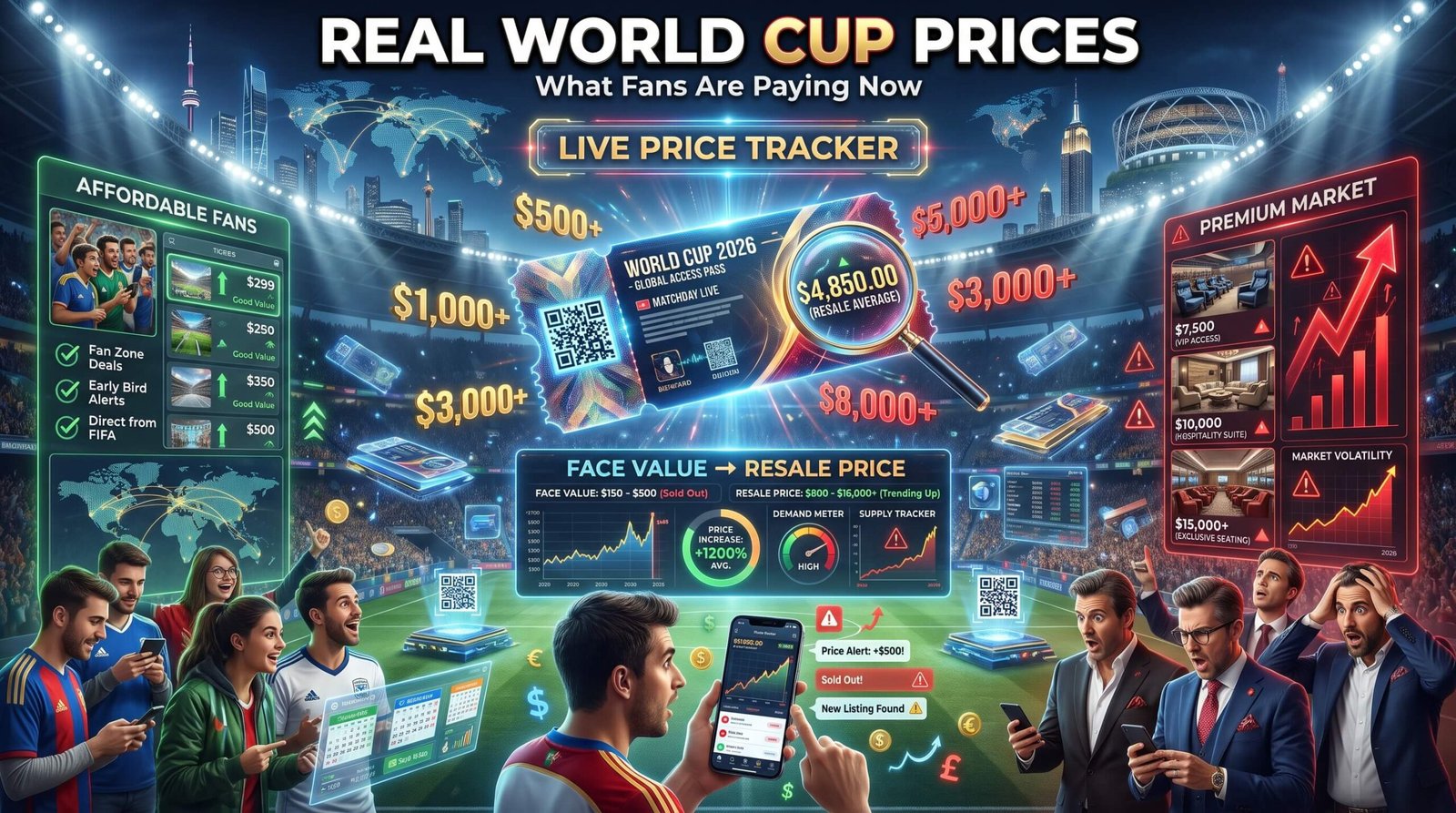
The 2026 FIFA World Cup is already being called the biggest sporting event in history, and the ticket market is behaving exactly like you’d expect from something this size. Prices have jumped, crashed, tripled overnight, and dropped by double digits within a single week — sometimes for the same match.
If you’re trying to make sense of what a World Cup ticket actually costs in 2026, the honest answer is: it depends entirely on which match, which round, and which day you check. This guide breaks down the real numbers, why they move the way they do, and where fans are actually finding seats right now.
The Tournament, By The Numbers
Before getting into pricing, here’s the context that explains why this World Cup’s ticket market is unlike any before it.
| Detail | Figure |
|---|---|
| Host countries | USA, Canada, Mexico |
| Host cities | 16 |
| Teams | 48 (up from 32 in 2022) |
| Total matches | 104 |
| Tournament dates | June 11 – July 19, 2026 |
| Group stage | June 11 – June 28 |
| Round of 32 (new round) | Begins June 28 |
| Round of 16 | From July 4 |
| Quarterfinals | July 9 – 10 |
| Semifinals | July 14 – 15 |
| Third-place match | July 18 (Miami) |
| Final | July 19, MetLife Stadium, New Jersey |
This is the first World Cup with 48 teams, the first hosted across three nations, and the first to use fully dynamic pricing from FIFA itself. All three of those firsts are shaping the ticket market in ways fans haven’t dealt with before.
How FIFA Actually Prices Tickets
Unlike past World Cups, FIFA didn’t set fixed prices for 2026. Instead, it uses a dynamic pricing model — the same logic airlines and ride-share apps use — where prices shift based on demand, how far out you’re buying, which teams are playing, and even the day of the week.
A few things are worth knowing before you buy anything:
- Seating categories run 1 to 4. Category 1 is the best view, Category 4 is the upper deck or corner sections. For 2026, FIFA redefined these tiers based on how high up the seat is, rather than by field position like in past tournaments — a change that hasn’t gone over well with fans who remember paying under $70 for a front-row seat in 2022.
- FIFA adds a 15% service fee on top of every ticket’s face value, official or resale.
- Weekday matches are cheaper than weekend matches, all else being equal.
- The cheapest official face-value tickets (as low as $60) belong to the Supporter Entry Tier, which isn’t available to the general public — it’s distributed through national football federations only.
What You’ll Pay By Tournament Stage
This is the part fans care about most, so here’s a realistic breakdown of what tickets are running at each stage, based on official face-value ranges and current secondary-market averages.
| Stage | Official Face Value (approx.) | Typical Resale Range | Notes |
|---|---|---|---|
| Group Stage | $60 – $500+ | $200 – $1,400 | Lower-demand matchups can be found near face value; host-nation games run much higher |
| Round of 32 (new) | ~$300 – $900 | $800 – $2,000 | Roughly a third of quarterfinal pricing |
| Round of 16 | ~$500 – $1,200 | $1,200 – $3,600 | Entry-level floor around $2,000 for popular matchups |
| Quarterfinal | ~$800 – $2,000 | $3,000 – $7,700 | Marquee pairings (e.g., Brazil vs. Mexico) push floors past $5,000 |
| Semifinal | ~$1,200 – $3,000 | $6,000 – $9,550 | A USA vs. France-style matchup would be the priciest possible |
| Third-Place Match | ~$400 – $900 | $800 – $1,500 | Prices fall back closer to group-stage territory |
| Final | Up to $7,875 | $8,000 – $38,000+ | Widest range of the tournament by far |
One pattern holds across every round: which teams are playing matters more than which round it is. A Round of 16 match between two heavyweight nations can easily out-price a quarterfinal between two lower-demand teams. If you’re chasing value, watching the bracket and buying before a big matchup is confirmed is consistently the smarter play — once a semifinal or final matchup is locked in, prices move within hours.
The Final: A Market of Its Own
The July 19 Final at MetLife Stadium deserves its own breakdown, because the price spread here is enormous.
| Seat Tier | Approximate Price |
|---|---|
| Cheapest available (upper deck, “get-in” price) | $8,000 – $9,775 |
| Average across all resale sections | ~$11,000 – $11,300 |
| Premium lower-bowl seats (Category 1, near pitch) | $15,000 – $38,000+ |
For context, some of the priciest resale listings for the Final have been reported north of $30,000 for a single ticket, and hospitality packages through official partners — which bundle tickets with food, lounges, and sometimes meet-and-greets — start around $5,000 per person and climb into six figures for the top-end experiences.
Why Prices Have Been Crashing Mid-Tournament
Here’s something that’s caught a lot of fans off guard: ticket prices haven’t just been climbing — they’ve been falling sharply as the group stage wrapped up and the knockout rounds began.
Tracking data shows that median get-in prices across the remaining knockout matches dropped by close to 40% in a single week as the group stage ended. The average resale cost for the cheapest Final tickets fell from roughly $11,600 to about $10,300 in the same window, down from a peak near $12,500 just two weeks earlier.
A few real examples make the pattern clear:
- A USMNT knockout match against Bosnia and Herzegovina saw resale prices drop from around $2,700 to roughly $1,650 in a matter of days.
- Meanwhile, Mexico’s game against Ecuador nearly tripled in price as the home crowd’s excitement built.
- FIFA also released a large batch of additional tickets through its official portal mid-tournament, temporarily boosting supply from under 2,000 available seats to over 10,000 — which is part of what pushed resale prices down.
The takeaway: World Cup ticket prices are not a one-way street. Supply drops, team performance, and last-minute inventory releases from FIFA can send prices in either direction within days — sometimes hours.
Where Fans Are Actually Buying Tickets
There are three real paths to a World Cup 2026 ticket right now, and they work very differently.
| Channel | Best For | Key Thing to Know |
|---|---|---|
| FIFA Ticketing Portal | Buying remaining official inventory | Last-Minute Sales Phase runs first-come, first-served through the end of the tournament |
| FIFA Official Resale/Exchange Marketplace | Reselling or buying verified tickets securely | The US/Canada version allows market pricing; the Mexico version (Mercado de Intercambio) is strictly face-value only, so sellers can’t profit |
| Secondary marketplaces (StubHub, SeatGeek, TickPick, Vivid Seats) | Availability for sold-out matches, especially close to kickoff | Prices float freely with demand; always confirm the ticket comes with FIFA’s official transfer system before paying |
If you go the secondary-market route, the one rule worth repeating: make sure your ticket is moved into your FIFA account through the official transfer feature. Tickets that aren’t transferred this way won’t get you into the stadium, no matter how legitimate the seller seemed.
Also worth knowing: FIFA has confirmed there’s no over-the-counter ticket booth at any of the 16 stadiums. If you don’t have a ticket in hand (digitally, in your FIFA account) before matchday, there’s no walk-up option — everything runs through the official portal or a verified resale channel.
Smart Buying Strategy for the Rest of the Tournament
A few practical takeaways if you’re still hunting for tickets:
- Buy before the bracket is confirmed, not after. Prices reset upward the moment a big team officially advances into a round.
- Weekday matches are consistently cheaper than weekend fixtures for equivalent rounds.
- Watch for FIFA’s supply releases. Additional official inventory has already been shown to knock thousands off resale prices within a day or two.
- Don’t assume later rounds are automatically more expensive than earlier ones. A blockbuster Round of 16 match can cost more than a quarterfinal between lesser-known sides.
- Factor in the 15% FIFA service fee on any face-value comparison you’re making — it applies across the board.
The Bottom Line
World Cup 2026 has broken the mold on ticket pricing — literally, since this is the first tournament where FIFA has let prices float with demand instead of setting them in advance. The result is a market that’s more unpredictable, occasionally more affordable, and definitely more exciting to track than any previous World Cup. Group-stage seats can still be found for a few hundred dollars, but a Final ticket is shaping up to be one of the most expensive single-game tickets in sports history — with plenty of movement left before July 19.
Whatever stage of the tournament you’re chasing tickets for, the numbers above should give you a realistic sense of what to expect, and a strategy for not overpaying when you don’t have to.