

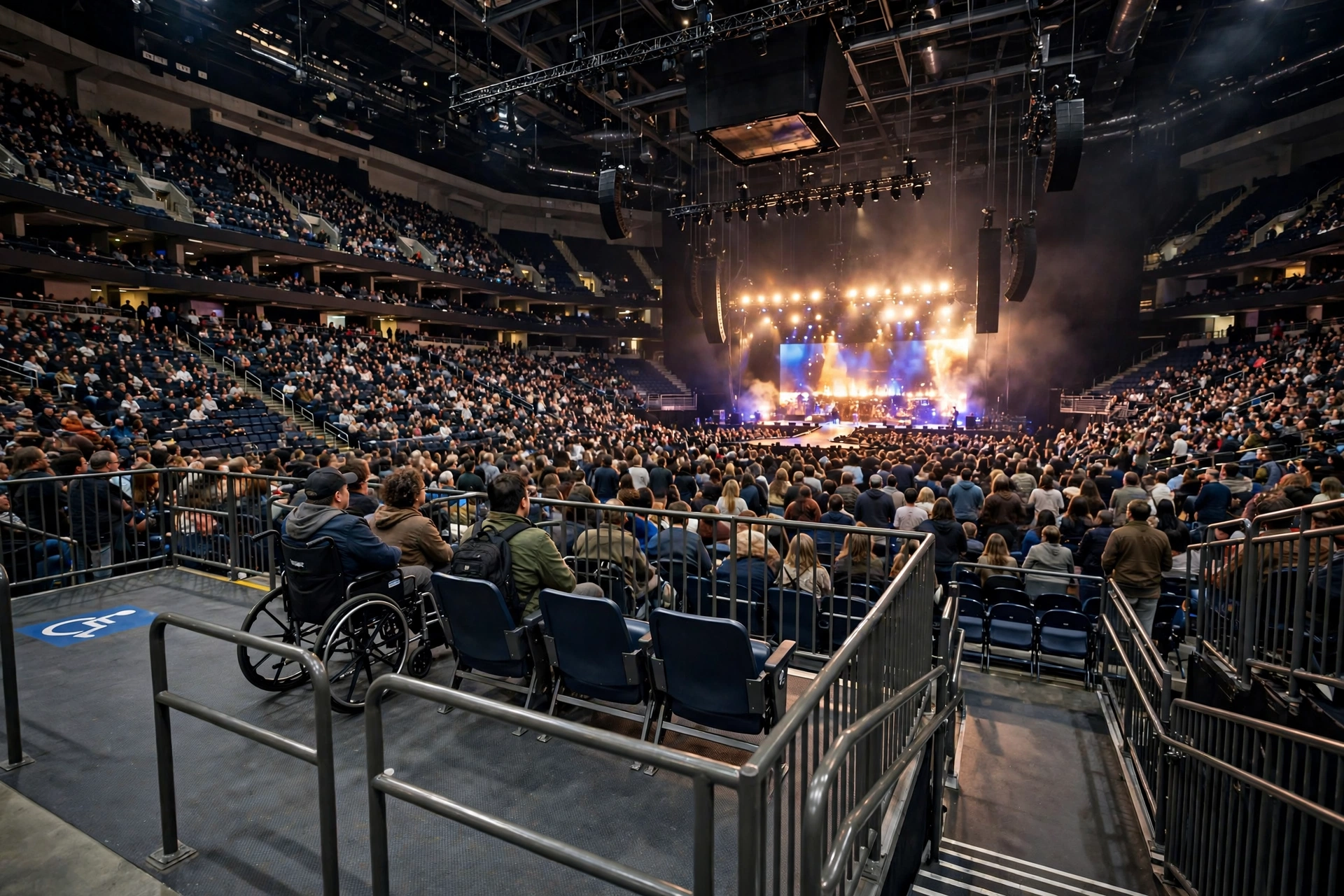
Buying accessible seating tickets works almost exactly like buying regular tickets — and that’s by law. Under the ADA’s ticketing rules, venues and the platforms that sell for them (Ticketmaster, AXS, SeatGeek, and others) must sell accessible seats during the same hours, at the same stages of sale (including presales), through the same outlets, and under the same terms as everyone else. You can’t be charged more than the people sitting around you, you’re entitled to bring up to three companions sitting next to you, and nobody can demand proof of your disability to complete the purchase. Here’s how to find, buy, and use accessible seats.
Your Rights Under the ADA Ticketing Rules
The U.S. Department of Justice’s ADA ticketing regulations (Title II §35.138 and Title III §36.302(f), in effect since 2011) set the ground rules for every ticketed event. The key requirements:
- Same hours, stages, and outlets. Accessible seating must go on sale at the same time as everything else — including presales, promotions, lotteries, and waitlists. If a third party like Ticketmaster sells the venue’s tickets, it follows the same rules as the venue.
- No price premium. Accessible seats can’t cost more than the seats around them, and they must be available at all price levels. In older venues where accessible seating can’t reach every section, a proportional number of tickets must be sold at each price level in a comparable accessible location.
- Companion seats. Anyone buying an accessible seat must be allowed to purchase up to three additional contiguous seats next to the wheelchair space, if available at the time of sale.
- Same purchase limits and information. If the public can buy four tickets, you can buy four too. Seat maps and pricing charts must identify accessible seating with the same detail as everything else.
- No proof of disability required. A venue may ask questions to discourage fraud, but it cannot require you to document or prove your disability as a condition of buying accessible seats.
How to Buy Accessible Seats on Ticketmaster and AXS
Ticketmaster sells accessible seating through its standard event pages. On the interactive seat map, look for seats marked with the ADA icon (wheelchair spaces) and the Companion icon — hovering over a seat usually brings up a box identifying it. Select the wheelchair space plus companion seats in the same row and check out like any other ticket. Some venues sell accessible seating outside the standard map: their Ticketmaster venue pages may direct you to an ADA request form or a dedicated accessible-seating phone line, and you can also buy in person at the venue box office.
AXS lists accessible and companion seating as ADA directly on event seat maps — look for the “Buy Tickets” option under Accessible Tickets on the event page, which filters the map to accessible inventory. For events where accessible seats aren’t shown on the map, AXS offers an Accessible Seating Request process through customer support: provide your contact details, the event, and how many wheelchair and companion tickets you need, and a representative confirms availability by email with a payment link. Never send credit card details by email — AXS processes payment through its own secure link.
On both platforms, accessible inventory is limited per event, so buying early matters just as much as it does for standard seats.
Companion Seats: How the Three-Seat Rule Works
- You can buy up to three additional seats contiguous with (right next to) your wheelchair space, in the same row.
- Those extra seats may themselves be wheelchair spaces if your party includes multiple wheelchair users.
- If three contiguous seats aren’t available, the venue must offer seats as close as possible to the accessible seat.
- Larger groups stay together whenever possible; if a group must split, people who need accessible seating can’t be isolated from the rest.
- Many venue pages default to one companion per wheelchair seat, but the ADA’s three-companion rule is the legal floor when inventory allows — challenge a lower cap with the box office if seats are clearly available.
Pricing and Dynamic Pricing of Accessible Seats
Accessible seats are not exempt from dynamic pricing — but they can’t be surcharged either:
- Accessible seats move with their section. Under dynamic or “Official Platinum”-style pricing, accessible seats are priced at their section’s current going rate — rising and falling with demand like everything else.
- But no surcharge is legal. An accessible seat cannot cost more than other tickets in the same section. Dynamic pricing can change the section price; it can’t add a disability tax on top.
- All price levels must be represented. Venues can’t relegate wheelchair users to only the most expensive or cheapest sections.
Practical tip: grab accessible seats early in the onsale — before dynamic pricing pushes the section up — and use any presale code you have, since accessible seats participate in presales too.
Buying Accessible Seats on Resale
Resale marketplaces list accessible seats when sellers list them, but seat labeling on resale is less reliable than on primary — a seller can mislabel a standard seat or list an ADA companion seat without the wheelchair space. Before buying resale accessible tickets, verify the seat location against the venue’s official seating chart, prefer official resale channels (Ticketmaster fan-to-fan, AXS Official Resale) where listings tie back to the original ticket record, and consider calling the venue box office with the section/row/seat to confirm the seats are genuinely accessible. Companion seats on resale may also be priced by the seller rather than by section rules — compare against primary prices first.
Day-Of Tips
- Arrive early. Accessible entrances and elevators get congested; venues generally open accessible entry at the same time as general doors.
- Ask the box office about exchanges. If your needs change (say, an injury between purchase and showtime), many venues will exchange standard tickets for accessible seats, subject to availability.
- Request extras in advance. Sign language interpreters, assistive listening devices, and audio description often need 10+ business days’ notice — contact the venue’s box office or accessibility email as soon as you buy.
- If the show is postponed or cancelled, accessible ticket holders have the same refund rights as everyone else — and if it sells out, our sold-out concert guide covers backup options.
FAQs
How do I find accessible seats on Ticketmaster?
Open the event’s seat map and look for seats marked with the ADA icon (wheelchair spaces) and Companion icon — hovering over a seat usually shows these labels. Some venues also sell accessible seating through an ADA request form or dedicated phone line on their Ticketmaster venue page.
How many companion seats can I buy with an accessible ticket?
Up to three additional contiguous seats next to the wheelchair space, in the same row, when available at the time of sale. If fewer adjacent seats are available, the venue must offer seats as close as possible.
Do accessible seats cost more than regular seats?
No. Under the ADA, accessible seats cannot be priced higher than other tickets in the same section, and they must be available at all price levels. They can cost less than surrounding seats — just never more.
Do I need to prove my disability to buy accessible seating?
No. Venues cannot require documentation of disability as a condition of purchasing accessible seats, though they may ask questions aimed at preventing fraud.
Are accessible seats affected by dynamic pricing?
Yes — accessible seats are priced at their section’s current rate, so dynamic pricing moves them like any other seat. The ADA only requires that they never cost more than the non-accessible seats around them.
What if a venue says accessible seats are sold out?
Ask the box office directly — some accessible inventory is held for phone or in-person sales and never appears online. Also check official resale channels and verify any resale listing’s seat location against the venue’s seating chart before buying.