

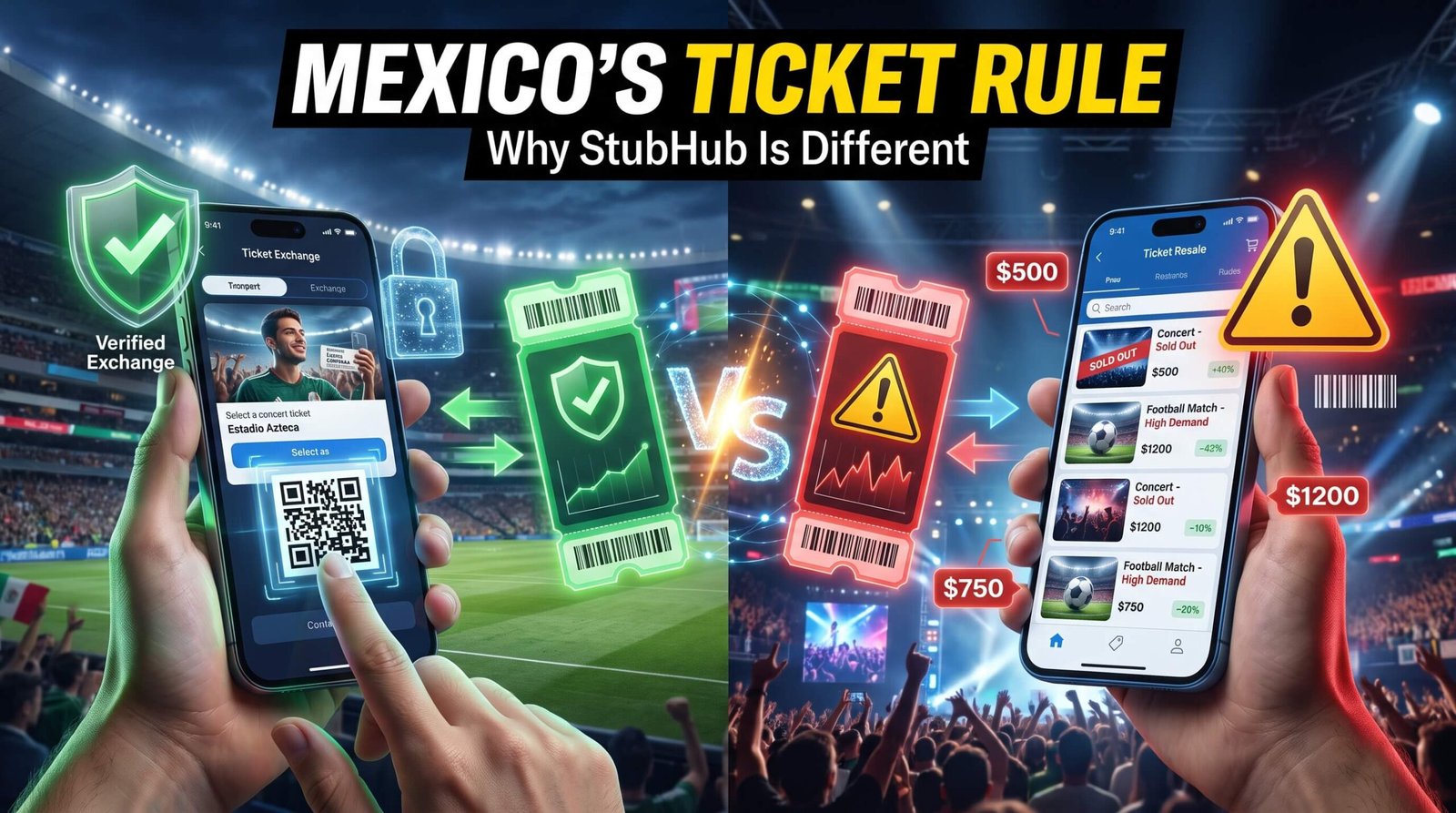
Sometimes people buy a World Cup ticket and then can’t go anymore. Maybe they got sick. Maybe their plans changed. So they sell the ticket to someone else. This is called “resale.”
There are different places where people can do this. Two of the biggest are:
- FIFA’s Exchange Marketplace — the official one, made just for Mexico.
- StubHub — a big website where people buy and sell tickets for lots of different events, not just the World Cup.
These two places have one big difference. And that difference can save you a lot of money, or cost you a lot of money, depending on where you live.
The Simple Rule: Mexico Says “No Extra Money”
If you live in Mexico and you want to sell your World Cup ticket, FIFA has a rule just for you.
You can only sell it for the same price you paid — or less. Never more.
So let’s say you bought a ticket for $200. You can sell it for $200. You can sell it for $150. But you cannot sell it for $250. FIFA won’t allow it.
This is called a “face-value cap.” It just means: no profit allowed. You can only get back what you spent, or a little less.
StubHub Doesn’t Have This Rule
Now let’s look at StubHub.
If you have a ticket and you want to sell it on StubHub, there’s no rule saying you have to sell it for the same price you paid. You can charge whatever you want — and buyers will pay it if they want the ticket badly enough.
So that same $200 ticket? On StubHub, someone could sell it for $500. Or $1,000. Or more, if the match is popular enough. Nobody stops them.
This is called “market pricing.” The price goes up or down based on how many people want it, not based on what the seller originally paid.
Why This One Rule Makes Such a Big Difference
Think of it like this. Imagine two kids at a lemonade stand.
One kid has a rule from their parents: “You can only sell the lemonade for what it cost you to make it. No extra money.”
The other kid has no rule at all. If it’s a hot day and everyone is thirsty, that kid can charge as much as people are willing to pay.
Guess which kid makes more money on a hot day? The second one.
That’s basically what’s happening here. Mexico’s rule protects buyers from ever paying more than what the original ticket cost. StubHub’s rule (or lack of one) means prices can climb very high, especially for popular matches.
What This Means for Real People Buying Tickets
Here’s why this actually matters, in plain terms:
- If you’re in Mexico, buying through the official Exchange Marketplace is safer for your wallet. You’ll never be forced to pay above face value. The worst thing that happens is you don’t find a ticket, because someone else grabbed it first.
- If you’re buying on StubHub, be ready to pay more — sometimes a lot more. For a big match, a ticket that started at $200 could cost you $600 or more by the time you buy it.
- Sellers benefit differently too. In Mexico’s system, a seller only gets their money back, not extra. On StubHub, a seller could make a real profit if enough people want the ticket.
Neither system is “wrong.” They’re just built for different goals. Mexico’s system tries to keep things fair and affordable for fans. StubHub’s system lets the market decide the price, which usually means higher prices for popular events.
A Real Example to Make This Clear
Let’s say Mexico is playing a home game, and demand is through the roof. Everyone wants to go.
On the official Mexico Exchange Marketplace, even with huge demand, a ticket that cost $300 can only be resold for $300 or less. The rule doesn’t change just because more people want in.
On StubHub, that same $300 ticket, for that same hugely popular match, could easily jump to $1,500 or more. Why? Because there’s no rule stopping the price from climbing when demand is high.
This is exactly the kind of situation where the two platforms feel like they’re playing completely different games — even though they’re selling the exact same seat, in the exact same stadium, for the exact same match.
One More Thing Worth Knowing
Even with this price protection, Mexico’s Exchange Marketplace still isn’t a guarantee. FIFA has said clearly: there’s no promise that your ticket will actually sell, or that you’ll find one to buy. The price rule just controls how much money changes hands — it doesn’t control whether a sale happens at all.
So if you’re in Mexico and hoping to grab a resale ticket, the price will be fair. But you still have to be quick, because good tickets can disappear fast, even at a capped price.
Why Does Mexico Get This Special Rule?
You might be wondering: why does Mexico have this rule, but the United States and Canada don’t?
The answer is simple. Mexico has its own laws about ticket reselling. In many parts of Mexico, charging way more than face value for a ticket — sometimes called scalping — is treated as unfair to fans, and there are rules against it. FIFA built its Exchange Marketplace to follow those local rules.
In the United States and Canada, the laws are different. Reselling tickets for a profit is normal and legal in most places. So FIFA’s marketplace for those countries works more like StubHub — sellers can set their own price, as long as buyers are willing to pay it.
This is really the heart of the whole story: it’s not that FIFA treats Mexico differently just because. It’s that FIFA has to follow the rules of whichever country it’s operating in, and Mexico’s rules are simply stricter about ticket prices.
What About the Fees?
Price isn’t the only thing to think about. There are also fees — extra money added on top of the ticket price.
On FIFA’s official marketplace (both the Mexico version and the regular version for the US and Canada), there’s a fee of 15% for the buyer and 15% for the seller. So if a ticket costs $200, the buyer might pay an extra $30, and the seller might lose $30 from their payout.
StubHub also charges fees, though the exact amount can change from listing to listing. The fees aren’t usually the biggest factor, though — the real difference between the two platforms is still that price cap in Mexico.
What If You Don’t Live in Mexico?
If you don’t live in Mexico, you can’t use the Mexico Exchange Marketplace to buy or sell tickets there. That marketplace is built specifically for Mexican residents.
If you’re visiting Mexico for a match but you live somewhere else, you’d most likely be buying through the regular FIFA Resale Marketplace (which allows normal pricing, like StubHub) or through a secondary site like StubHub itself. The special no-profit rule only protects Mexican residents using their own local marketplace.
A Second Example, Just to Be Extra Clear
Let’s try one more example with different numbers, just to really lock this in.
Imagine a ticket for a Mexico match costs $150 to buy from FIFA.
- On Mexico’s Exchange Marketplace: the highest anyone could resell it for is $150. Maybe less, but never more.
- On StubHub: if it’s a big, exciting match, that same $150 ticket could be listed for $400, $700, or even higher, depending on how badly people want to go.
Same ticket. Same seat. Same match. Two very different possible prices, just because of where and how it’s being resold.
Common Questions About This
Can a Mexican seller ever charge more than they paid, even a tiny bit? No. The rule is firm — face value or lower, with no exceptions for demand or excitement around a match.
Does this rule apply to every ticket in Mexico? It applies to tickets resold through FIFA’s official Exchange Marketplace, which is the platform built for Mexican residents. Tickets bought or sold outside official channels aren’t protected by this rule, and FIFA warns those tickets could even be cancelled.
Is StubHub allowed to sell World Cup tickets at all? FIFA doesn’t officially authorize StubHub to resell World Cup tickets, even though StubHub still lists them. That’s a separate issue from the price-cap question, but it’s worth knowing if you’re deciding where to buy.
Which platform is better? It depends what you care about most. If a fair, capped price matters more to you, Mexico’s Exchange Marketplace is the safer bet. If you care more about finding a ticket at all, even at a higher price, StubHub usually has more listings to choose from.
The Short Version
- Mexico’s official ticket exchange only allows selling at face value or lower. No profit allowed.
- StubHub allows sellers to charge whatever buyers are willing to pay, with no cap.
- This means the exact same ticket can cost very different amounts depending on which platform — and which country’s rules — you’re using.
- If you want the fairest price, Mexico’s system protects you. If you want the biggest selection, even at a higher cost, StubHub usually has more available.
Knowing this one rule can save you from a nasty surprise — or help you understand why the same seat costs so differently in two places.